



Preservation of a unique fish fossil from Fur
In August 2024, Frank Osbæck, conservator at Museum Salling, will begin the extensive work to complete the conservation of one of the most remarkable fossils in the Fur Museum collection.
Discovered by a German collector in the 1980s, the fossil not only has unique scientific value, but has also played a key role in the creation of the Danekræ legislation, which ensures the preservation of natural artifacts in Denmark. The project is expected to run until 2025 and will significantly increase both the scientific and exhibition value of the fossil.
What will happen:
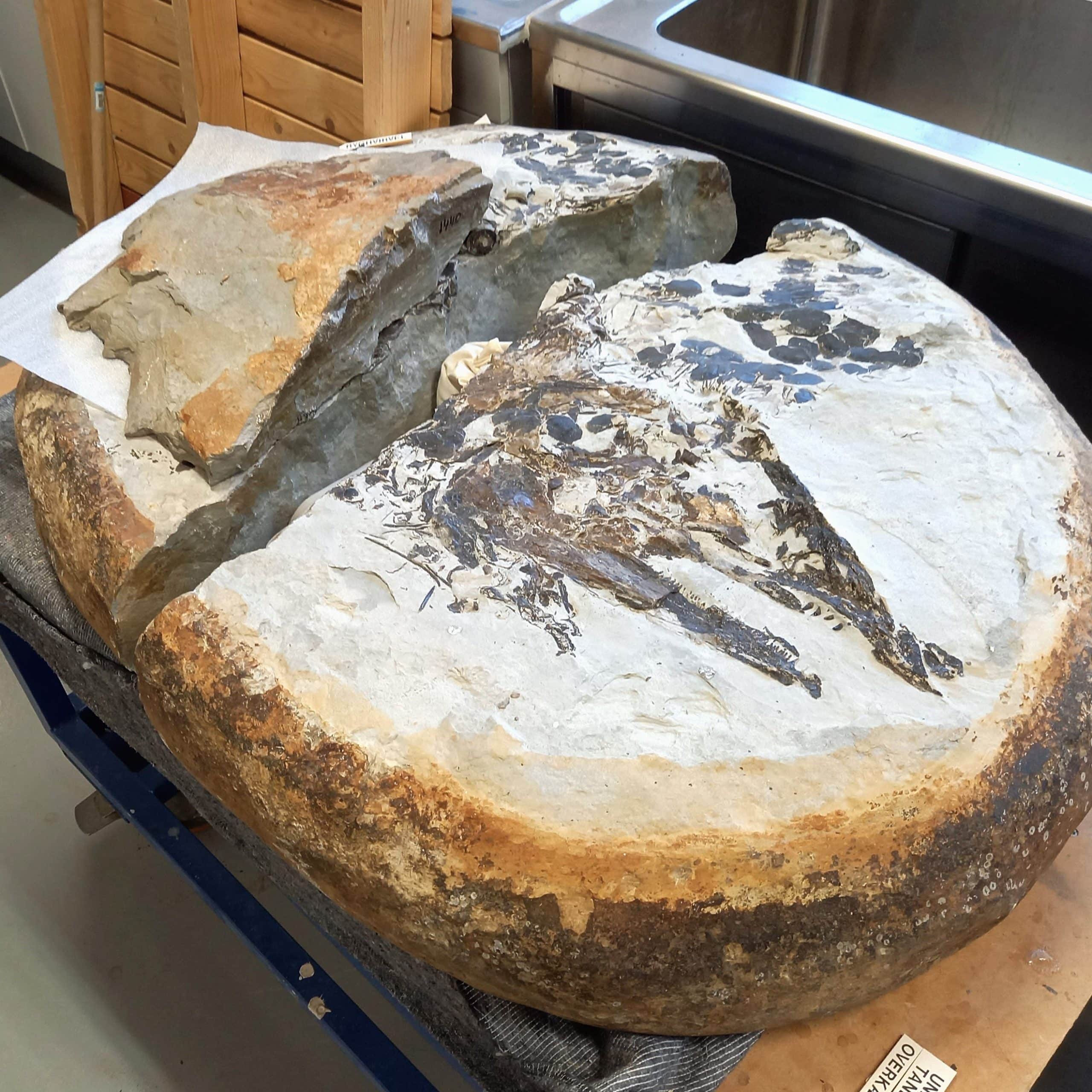
The aim of the conservation is to prepare the skull and anterior part of the unique fish fossil from Fur. This is the complete skull of probably the largest fossil fish ever found in Denmark. By exposing the fossil, the museum will be able to display it in its full splendor, which will be of great importance to both researchers and visitors to the museum.
Geologist and museum curator René Sylvestersen says: “It requires a very special knowledge to expose and preserve such a unique fossil like this. We are therefore lucky to have Conservator Frank Osbæck to help us with the task, as he is the only one in Denmark who can perform acid preparation and mechanical preparation at such a high level as this task requires. The work will be very time-consuming, and we estimate that more than 1000 man-hours will be needed for the task of exposing the fossil. The salary costs for the project will be covered by a grant from the Ministry of Culture.”
The historical significance of the fossil:
René Sylvestersen continues: “On June 18, 1985, Fur Museum received a postcard from a German tourist who wrote that a large fossil fish was buried under a stone circle on Furs Nordstrand. The postcard, which had a circle around the spot, set museum curator Erik Fjeldsø Christensen on an exciting discovery. That evening he found a cement stone containing the fossil of a large fish. The stone was recovered the next day, but the German tourist had already taken the top part of the fossil home.”
Although it was perfectly legal, the postcard ensured that the museum got one half of the fossil. The following year, the tourist offered to lend the museum the top half of the fossil for five years in exchange for the museum taking care of the preparation. This incident led to a lot of press coverage and became a catalyst for the introduction of the Danekræ legislation, which protects natural artifacts. In 1992, Fur Museum acquired the upper part of the fossil and the giant fish now returns to Fur, where it lived 55 million years ago.
The scientific value of the fossil:
The fossil is a holotype of the species Furichthys fjeldsoei, named after the island of Fur and the late museum director Erik Fjeldsø. The fossil belongs to the fish order Osteoglossiformes, where the 245 living species today live in freshwater in South America, Africa, Australia and southern Asia.
“The fossil found in the molar at Fur is unique because it proves that Furichthys fjeldsoei lived in saltwater 55 million years ago, long after the supercontinent Gondwana began to break up. This makes the fossil scientifically significant in the field of paleobiogeography, as it challenges previous theories about the origin and spread of the fish order,” concludes René Sylvestersen.
For further information contact:
Geologist and museum curator René Sylvestersen
E: rlsy@museumsalling.dk
T: 99156935